
Stop Managing Projects by Email: Modernize Oversight Now
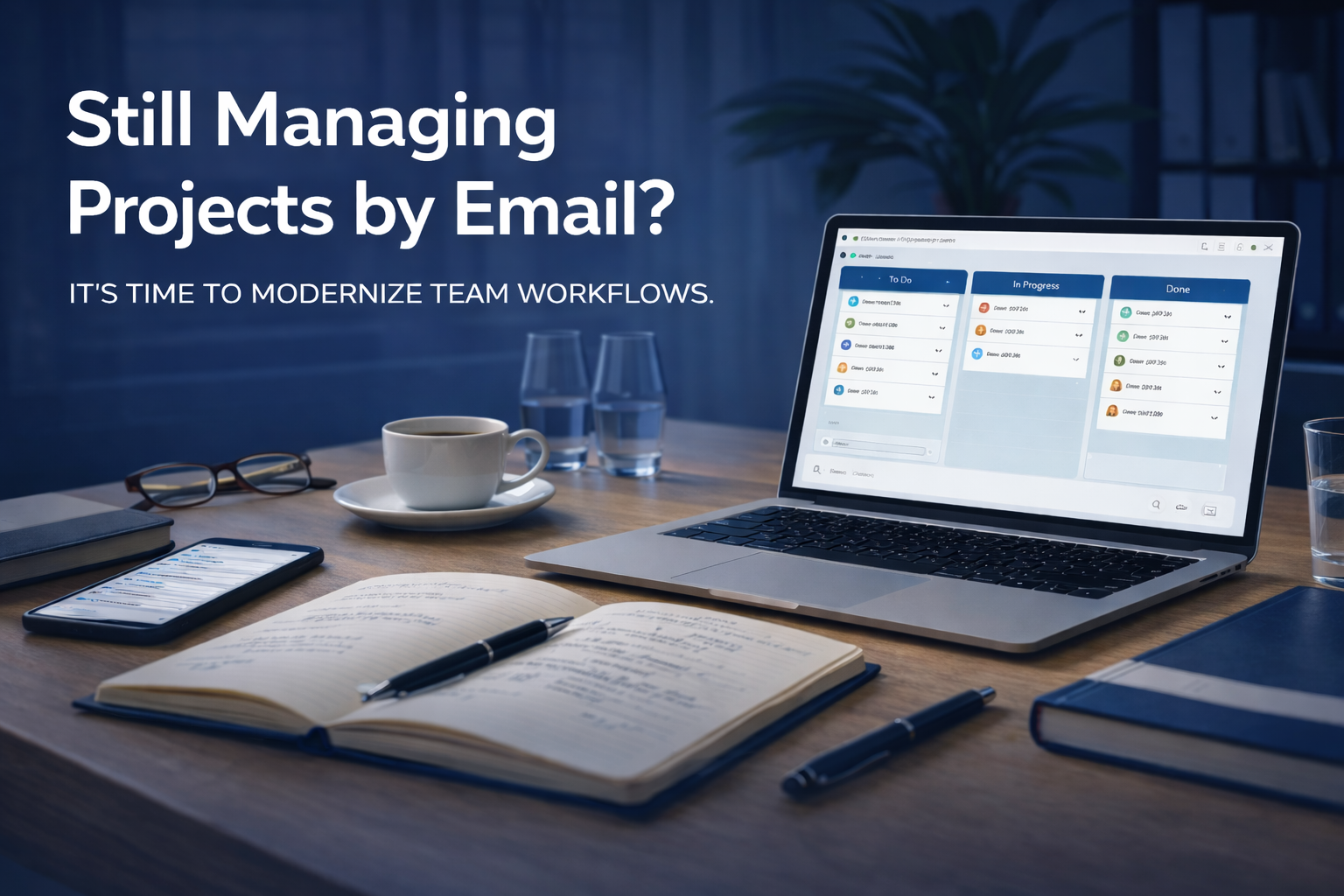
Email isn’t a project management system. Shared work needs shared visibility.
Email and notepads can’t carry shared accountability and real-time visibility.
“If the work is shared, the system has to be shared.” — Eric Wiley
What’s changed (and what hasn’t)
As we move deeper into this decade, many well-established small and mid-sized businesses are running into a familiar issue. The work is more complex, teams are more distributed, and expectations around visibility and follow-through have changed. In many cases, however, the way projects are managed hasn’t changed at the same pace.
Email inboxes and personal notes are still doing far too much of the work. That approach may feel efficient from an individual standpoint, but it breaks down quickly once projects involve multiple people, handoffs, and dependencies that matter.
Where the friction shows up
This isn’t really a generational debate, even though it often gets framed that way. Gen X, Millennials, and Gen Z simply grew up with different relationships to information and shared systems. That difference becomes obvious when work needs to be tracked, updated, and coordinated across a team.
Most employees today expect to be able to see:
- What’s being worked on
- Who owns each item
- What’s stalled and needs attention
- What has changed since the last update
When that information lives in email threads or in someone’s private notes, teams lose context. Updates get repeated. Decisions are harder to trace. Accountability becomes unclear. This happens because analog systems were never designed to support the way work now gets done.
The leadership shift that matters
Even if you personally prefer pen and paper, your team needs shared, visible workflows.
Leadership today is less about personal productivity and more about enabling coordinated execution. That means moving away from tools that only work for one person and toward systems that allow everyone to operate with a clear picture of what is going on.
You don’t need to be highly technical or entirely throw away your leadership style. If you can use Outlook or any modern communication tool, you can use project management software well enough to stay informed, review progress, and participate where it matters. Mastery isn’t necessary – just presence and consistency.
When leaders actively use the same systems their teams rely on, it removes friction and sends a clear signal that the work — and the process behind it — matters. The opposite is also true…
What happens when adaptation slows
Organizations rarely lose good people because of a single event. More often, it’s the result of accumulated signals.
People will look elsewhere if they determine that an organization’s rate of adaptation will hinder their own career growth. Don’t hold your people back!
When project management remains stuck in email and side notes, capable employees begin to question whether the organization is serious about improving how it operates. Over time, outdated workflows communicate limits — even if that isn’t the intent.
Oversight without becoming the bottleneck
Well-used project management tools reduce bureaucracy.
When implemented with discipline, they provide:
- Real-time status
- Clear ownership
- Fewer check-in meetings
- Cleaner handoffs
- Faster course correction
They also allow leaders to maintain visibility without chasing updates or inserting themselves into every conversation. That’s real oversight and awareness without micro-management.
A lightweight starting play (no overhaul required)
If your team is currently running projects out of email, don’t try to fix everything at once. Pick one active initiative and modernize the workflow around that single project first. The goal is shared visibility and clean ownership.
- Choose one project that matters and name one accountable owner.
- Set up a shared board (simple is fine) with three columns: Not started, In progress, Done.
- Create tasks with an owner and a clear next action (not just a topic).
- Move updates out of email and into the task itself so context stays with the work.
- Review the board once a week for 10 minutes: what’s stalled, what needs a decision, what’s next.
This is the smallest shift that changes the tone: people stop chasing updates and start moving work.
Bottom line
If you want your organization to remain effective:
- Stop trying to manage projects through email
- Let go of private tracking systems
- Adopt legitimate project management workflows
- And visibly support the tools your team depends on
The digital project management shift has already happened. What remains is whether leadership systems reflect that reality or quietly work against it.
If this feels familiar, you’re not alone.
At Wiley Performance Advisory, I work with leadership teams to modernize workflows in a practical, human way — without overengineering or forcing tools that don’t fit how the business actually runs.
If you want clearer visibility, better execution, and systems your team will actually use, let’s start with a conversation.
— Eric Wiley
Wiley Performance Advisory
Your Wingman on the Next Big Push.